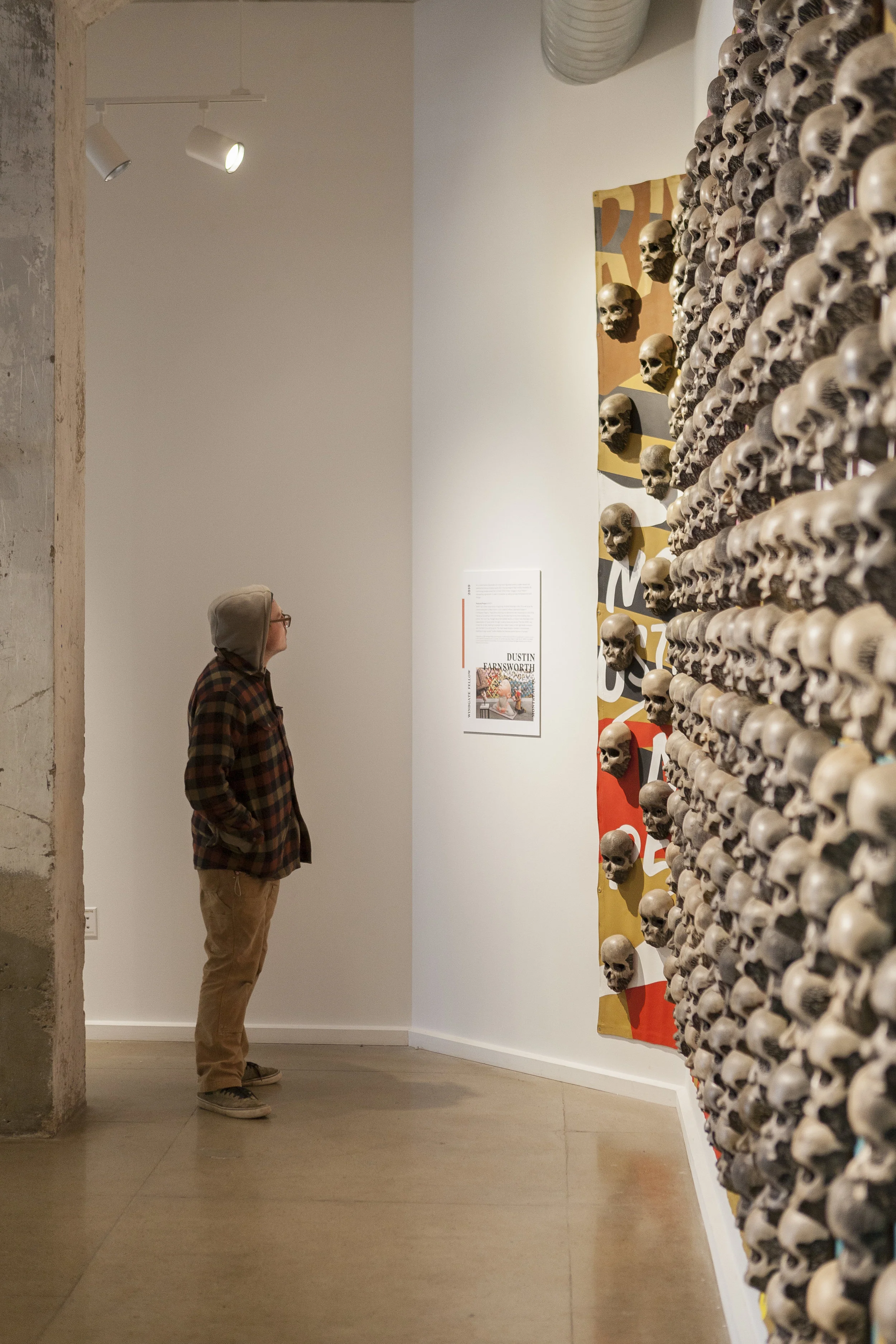
Center for Craft: Photo essay

Clay, Stone & Wood:
Local gallery exhibits work of art fellows
Words and Photos by Nick Haseloff


The Center for Craft showcases art from grant recipients
As a celebration of the 10th anniversary of their Windgate Fellowship, the Center for Craft features work from 10 of its grant recipients in exhibition titled Scale Up: 10 Years, 10 Fellows, 10 Projects.
The gallery, located on Broadway Street in downtown, showcases art of many different varieties but the majority of the work on display from the Windgate Fellows is sculpture.
The art attempts to expose ideas surrounding scale, installation and community practice according to the center's website.
The exhibit will be on display until late July and feature multiple talks and events during its duration. The Center for Craft is open to the public and donations are accepted at the reception desk.
The Center for Craft is located at 67 Broadway St. Asheville NC 28801
Podcast - A conversation with Javier and L.A. from Black Star Line Brewing in Hendersonville, NC
By Nick Haseloff
After interviewing L.A. McCrae earlier this Fall, before their brewery Black Star Line Brewing officially opened, they received some hateful messages on their website. This podcast is a discussion with L.A. and their new COO Javier Naranjo about the brewery and its future.

Transcript:
Nick: So I’m here with Javier Naranjo and L.A. McCrae of Black Star Line Brewing. And we’re here to talk about their opening and stuff that’s been going on with the brewing industry in the Hendersonville and Asheville area and culture and community. How have things been going since you’ve opened?
Javier: You want to take that?
L.A.: I’m going to let you take that.
Javier: It’s been going Well. Despite some speed bumps here and there, I think it’s been going pretty well. The people here are great. They’ve been super responsive to us. I think we’re really honing in on some good beers here. I think despite all of the challenges with the start up, long hours and what not, some days we’re just like ‘oh man can the day just be done.’ We’re having fun all the while. It’s been a lot of fun. Not so fun sometimes. Overall it’s been great.
Nick: What about you L.A.? Has it lived up to your expectations? Because when I last talked to you, you were right before it and you were freaking out a little bit.
L.A.: Yeah I think I’m unsure as to what I thought this was gonna be. So any expectations that I thought I had have clearly all just been dashed away. I think I want to echo what Javi said. It’s a lot of work but it’s a labor of love. So as I look over at our fermenters right now, those are our babies right now. Some people have fur babies, we have beer babies. So each birthing, from the conception of the beer baby to the idea, to the process of helping it get into its incubators, also known as fermentation vessels, and getting the finished product out, it’s deeply satisfying to go from an idea to tasting. And it’s literally the taste of satisfaction. What's been the most heartwarming and the face of those challenges is the out warming the outpouring of support from our community hands down Kendra Penland from the Asheville Brewers Alliance Derek Allen the folks from Hillman, Triskelion, of course Joe and Lisa over at Sanctuary these folks have welcomed us who were more or less strangers into the family with big warm openness hugs Smiles mentoring guiding and we are just grateful beyond words for their witness to what the craft brewing industry really is so big shout out to the homies that hold black star line down.
Nick: That’s awesome. And you’ve been proud of the product you guys are producing and have you had a good reception from the community, the people coming in trying the beers?
Javier: Most definitely. Yeah right now we have an IPA upstairs. I’m excited about that because we had no intention of making a super hoppy IPA ever. Sweet beer movement, right? That’s one of the themes here for us is to have like malty beers. But we’ve been looking for an IPA and we’re like ‘okay, okay, we’ll do it.” And Kay, who designed this IPA, she hit it out of the park.
L.A.: Absolutely.
Javier: Out of the park. Yeah so I think we’re doing some good stuff upstairs and down here.
Nick: So you were telling me that six weeks ago, you didn’t even know how to brew beer.
Javier: Right, right. So…
Nick: What is it like learning on the job, especially with L.A. in charge?
L.A.: Well I don’t know about L.A. being in charge. I would say that’s not necessarily true.
Javier: It’s a back and forth dialogue. And sometimes that dialogue is yelling and then whispers, and then no dialogue. But learning how to brew on this tiny guy, I am on this guy all the time. And when I say ‘this guy’ I’m on the boiler, I’m on the mash. All day long. So it’s been… the learning curve is high, but you know I’ve just been kinda ramping it up. And I have a degree in chemistry. Doing this isn’t just laborious, it’s very engaging for my mental so… yeah it’s been good.
L.A.: I think it’s pretty cool, Javi and I know each other through a mutual friend so we had never met before and I said ‘sure come down’ he said ‘let’s talk on the phone’ and I said ‘well, give us a couple weeks and we should be able to pay you.’ And I think Javi is still waiting for dollars and cents. It’s been weeks at this point. But literally he drove down here in one night. He got here tired, eager. He had a… it wasn’t a panini…
Javier: It was a whole calzone
L.A.: It was a whole calzone. I was so hungry. And so he had it. We were eatin’ it. And I was like ‘okay cool, you need to help us with the mash out.’ So we started mashing out. And from literally the time he arrived, ten toes down in Hendersonville, has been brewing. So I really appreciate that it feels… we say this often, that we’re parents of the brewery, we’re parents of the beer. Collaborate on recipe design, Javi really carries them out. So what you’re tasting right now has literally been fermented by Javi’s hands. It’s really awesome to have a true partner in this. And to be going through the stages of this, with someone who is equally devoted, committed, and who’s parenting the child that is Black Star Line.
Nick: That’s awesome. That’s awesome. So when we talked last, it was right before Black Star Line opened, like I said. And you were talking about creating community empowerment through this brewery. What steps have you taken now that you’ve opened? And what successes have you had?
L.A.: That’s a great question.
Javier: So our staff, is a pretty nice cast of characters. So big shoutout to everyone here. Upstairs, down here all the time. In terms of community, we’ve held some kinds of events, kind of…. So for example Our Table, Our Table is an event that we had right before thanksgiving. We wanted to kind of have some healing space and some place for family and love in the wake of some of the violence that happened these past couple months. Whether it be Vegas, or was it Texas? Texas. And so.. Just having that intentional event to get people through the door and to feel warm and to feel that there’s some sanity in the world and there’s some unity.
L.A.: That’s pretty good.
Javier: And we hope to continue events like that. Hopefully not in response to such horrific things, but just, you know, just to bring people in again and you know it’s just a big community hug if anything else. You know what I mean?
L.A.: I’ll add to that. Last week we had an opportunity to meet with folks from nuestro centro, and thinking about ways we can partner and collaborate with indigenous communities and the types of things that we can really hold space for. I think that’s really critically imperative to us fulfilling our social mission. So we keep our eye on that every day and it really informs all of our decision-making.
Nick: Okay, okay. So social media has kind of blown up with you guys in the past couple weeks about some things that were said through emails I think. Or through your website. If you could, fill in people that are listening to this that haven’t heard about it. Tell us your side of the story. What happened?
Javier: Yeah so it was through our business website. On the business website there is a text box, a field right there where patrons can kind of put in feedback, suggestions for the bar, suggestions for beer and what was once a tool for, you know, constructive feedback, had become a vehicle for spewing hate and for threats. I don’t have the message right in front of me but the essence of it was: the identity of some of the people that work here are not welcome, and essentially they should die. Which was really jarring. The first day that messages like that started coming in, the first one was like as simple as: ‘we comin’.’ And we’re like ‘okay this is some kid.’ And then by the end of the second or third day, the last message we got was pretty threatening. Kind of scary actually. And we had a decision to make. We either stay quiet or we say like ‘This exists.’ And so L.A. and I and a few others got together to kind of process ‘Do we put this out there?’ And ultimately we decided that there needed to be a spotlight on it. And the community really did show up.
Nick: I heard there was a gathering or a protest?
Javier: Not a protest. I think what happened once we exposed it was like… So let me say something first. That message, the messages we got through the website, We know that it is nowhere near representative or indicative of the people who live here. It’s an unfortunate, you know, just small population of people who think like that. And we know that. The community knows that. And the support that came out afterwards, was just like ‘Yeah. That doesn’t stand for us and…’ Basically... Can we swear on this show?
Nick: Go for it.
Javier: ‘Fuck that shit.’ You know the people here were like ‘Fuck that shit.’ Yeah, so the response was incredible. There were the obvious people we see every day but people came out of the woodwork. People came from far and wide to say ‘Fuck this shit.’
L.A.: I think probably one of the most awesome things was the high school students...
Javier: The high school students. Oh my god.
L.A.: ...who wrote us letters.
Nick: Are these from local area high schools?
Javier: Yeah. I’m not sure if we’re allowed to say from where. But they were so touching. There was event going on downstairs and I came downstairs to grab something and I saw the envelope open and saw the handwritten letters and I just sat down. I totally forgot what I was doing upstairs. And just wept dude. I just wept. I was so touched. I’m getting kind of choked up just thinking about it. These letters are just so cool. These are young people who, with such emotional intelligence. It’s good to see that next generation or the generation that we have now is just, that they’re there. They’re taking the steps to connect with people they don’t even know.
Nick: I think as bad as the things that were said on your website were, they really helped to show people that you guys really do have support and to bring the conversation up.
Javier: Yeah so unfortunately it had to come through that avenue, but yes, yes.
Nick: So have you received anything recently? Or has it continued on? You guys have been pretty alright with not seeing that sort of hate towards you? That’s very good.
L.A.: So to respond: No. We have not seen anything and we’re really encouraged by the community and the folks who were showing up to have on-the-ground support. I know a lot of the local business owners are coming in to check and see how we are. And the police department, the Hendersonville Police Department, has gone above and beyond making sure that we’re protected, being on patrol, the chief of police has come in a couple of times. So we really feel like the community has taken a strong stance that this type of bias, bigotry, racism, hatred will not be tolerated in our community. And Javi and I are residents of Hendersonville.
Nick: That’s really awesome. I’m really glad that you guys have been seeing that support. So what’s the future of Black Star Line? What are you guys gonna do in the next coming months, coming years? What do you guys have planned in the woodworks?
Javier: So coming years are like the dream, right? And then the nearby stuff is more like, we’re just putting our head town and getting to work. As far as where we want to go, we just want to make sure that this kind of space is available not just to the folks out here. We want to make sure that as we grow, wherever we go, if we choose to go somewhere else, that we can do this better and better each time.
L.A.: Yeah I think the anecdote about that last year, when I was really deliberating on the name for the brewery. And settled on Black Star Line Brewing Company. I was talking to a woman at the Juneteenth Festival over in Asheville and she just began to weep because she understood what that means for folks of the African Diaspora. Folks that are aware of the UNIA, the Universal Negro Improvement Association. So as I think about our recent trials and tribulations, I happen to be cleaning out Javi’s room which had some of my old notebooks, and today was talking to someone and happened to flip upon notes that I wrote about Marcus Garvey. And when I flipped it over, the very first thing at the top of this page, was ‘Black Star Line.’ Right? So this is not something new for me. And as I’m rereading these notes and always going through a process of re education, further education, I’m reminded that when Black Star Line was created, not far from my home in Maryland, people were angry, people were upset. Marcus Garvey started with essentially no money. Black Star Line was started with zero dollars, was just a dream. They dealt with a lot of distorted views from folks on the outside. Often really trying to narrow down the message of ‘This is what we’re trying to do with Black Star Line.’ Right? And had a heck of a lot of adversity. So thinking about that, thinking about those that just essentially would go on to fully sabotage Black Star Line, the reason that Marcus Garvey got deported from the United States. It’s interesting that we chose this name and that this has been our experience at the beginning and thinking about ‘What are we about almost a full century ago?’ The same types of things happening to Black Star Line. And I think it’s really important for folks to know who are listening that yes we do have an aggressive social mission, and we have some pretty kickass beers. At the core of what we’re doing is making great beer. And we take a lot of pride at making great beer, collaborating with those who are in our brew family locally and even across the northeast seaboard. And that’s what we want to be known for. We want to be known as a whomsoever bar that makes really great beer. Really great sweet beer.
Nick: Yeah. Are there any interesting brews that are gonna come up in the next couple weeks? Or any interesting collaborations?
Javier: I wish I could tell you about this one I’m doing. I wish I could tell you. I can’t. There’s a competition this coming weekend. Yeah I have something that touches close to my home, to my heart, so the ingredients in it are reminiscent of my family’s culture. So my dad’s Mexican, and that’s it. That’s all I can give you about that. So look forward to that. But in terms of other beers, I think right now we’re concentrating on honing in our flagships. Which are:
L.A.: Dat Dere Ginger Beers, Dopely Stout, the Pullman Porter, the Lord Honey Pilsner, the creamsicle.... pale ale, we’ll call it the Creamsicle Pale, Amber’s Ale. My name is Amber. Laura Amber, everyone knows delete that. Delete, delete.
Javier: No it’s too late.
L.A.: It’s too late, it’s too late. Now everybody knows the L.A. and probably one of our most popular, named after James Baldwin, Juicy Jimmy’s Pale Ale.
Nick: That’s a good lineup. That’s a pretty big lineup.
L.A.: Yeah and the Crusha. Of course the Crusha IPA.
Javier: Yeah big shout out to Kay for that one.
L.A.: Hey Kay!
Nick: Alright, I think that should wrap it up. If there’s anything else you guys want to add, feel free to.
L.A.: Find us on social media, especially Instagram. Send us your favorite selfies.
Javier: Yeah if you want to see a picture of me and L.A., we’re all over that.
L.A.: Yes, we’re about to take a picture right now with Nick.
Nick: Okay.
L.A.: Alright. Thank you so much.
Nick: Thank you.
Javier: Thank you.
Hendersonville brewery raises community morale and provides sanctuary for animals
By Nick Haseloff
Most breweries focus only on producing beer, but one small brewery in Hendersonville is looking to strengthen their community and give shelter to animals in need while crafting unique and modern brews.

Patrons mingle at the bar at Sanctuary Brewing in downtown Hendersonville. The brewery opened its doors two years ago with the mission of animal advocacy and community empowerment.
Photo by Nick Haseloff
Sanctuary Brewing Company opened its doors two years ago, and from the start, the owners decided to create an atmosphere that was different from many breweries in the area. Lisa McDonald and Joe Dinan are co-owners of the brewery and said that they knew from the start that they were going to accomplish more than just brewing beer.
“We have this unique social responsibility and this community-driven focus,” McDonald said. “It started out with animal advocacy and then grew from there.”

Lisa McDonald
Co-Founder and Co-Owner of Sanctuary Brewing
McDonald and Dinan said they moved to Western North Carolina from Chicago and created a animal sanctuary on the three acres they lived on. They started with just a few dogs but their farm quickly grew to 13 animals of all shapes and sizes.
“The farm is only a couple miles from the brewery so it’s nice to be able to go back and forth and check on the chickens or play with our pig,” McDonald said.
The animal sanctuary they created earned its 501(c)(3) status as a non-profit organization recently and McDonald said she looks forward to what the future has to bring. They plan to develop their animal care efforts alongside their brewery.
“This new designation is really good news for us and means that we can expand our animal care even further,” McDonald said.
When Dinan and McDonald set out to open their brewery in 2015, they wanted to form a business that could support their animal care efforts and vice versa. They named the brewery Sanctuary as an homage to their message.
“Since the day we opened, we’ve kind of looked towards the community instead of towards ourselves,” McDonald said.
The brewery is host to an animal adoption event every week and a multitude of other events that center around the community throughout the year she said. Some of the events include yoga with cats, live music, benefits for local non-profits, trivia nights and a weekly community meal that is provided free of charge.
“The whole idea of Sanctuary goes a step further, as this is a safe haven for people that might not be accepted in other places,” McDonald said. “We’re very open minded. I didn’t think this town would ever have a place like this. I think it’s easy to gravitate to this place because it creates a sense of warmth and happiness and kindness.”
Events focused on people hosted at the brewery center around people that are marginalized or need help getting back on their feet. The philanthropic nature of the brewery makes it unlike many of its peers.
“The brewery here has become much more than a place to come in for a couple beers,” Dinan said. “It’s a meeting spot, it’s a spot for families to come, it’s a place for people ages 8 to 80 to come.”
Dinan and McDonald attribute their altruistic approach to business to their success in the community. They said many of the patrons of the brewery are regulars and often participate in the events they host.
“There are a lot of breweries that make good beer,” said Troy Colbert, blogger, beer fanatic and frequent patron of Sanctuary Brewing Company. “What sets Sanctuary Brewing Company apart is that they make fantastic beer and through their animal rights activism and their strong community ties have an eye on making the world a better place. They have made Hendersonville a better place to live.”
Dinan, who acts as head brewer, said the beer they brew is made to suit many different tastes and works off of seasonal flavors and ingredients.
“About half of the beer is something seasonal or a staple and the other half is just stuff I’m interested in brewing,” Dinan said. “I’m just trying to put out a consistently good product that is pushing the envelope of the scene.”
Dinan said the brewery tries to support the community in their brewing as well. When possible, the brewery purchases fresh ingredients from local farmers.
“We try and go local as often as possible but it can be tricky,” Dinan said. “Sometimes you want to brew a beer with something that’s out of season locally. But when we can, we try and get our ingredients from around us.”
Sanctuary Brewing Company also supports other local breweries in the community. Black Star Line Brewing opened shop last month in Hendersonville and Founder L.A. McCrae said the help they received was pivotal in their success.
“Joe and Lisa have been a huge help in starting up Black Star Line,” McCrae said. “They’ve really devoted a lot of themselves to helping us get started.”
Dinan attributes most of his success in brewing to time he spent in other breweries learning the trade. He said the best thing new breweries can do is to get as much experience as possible before they start.
“It’s stressful as hell opening up a brewery,” Dinan said. “And the more you can prepare yourself for that first year, by working at another place or learning in a program, the better chance you’ll have.”
Dinan and McDonald said that they don’t think there will be a limit to the number of breweries that the economy can support in Western North Carolina.
“Nobody ever talks about coffee house saturation or roastery saturation and there’s probably triple if not quadruple what there is in coffee compared to breweries,” McDonald said.
They are thrilled to see new breweries popping up in the surrounding area and welcome newcomers in Hendersonville as well.
“Our doors are always open. So if anybody ever has a question, if they want to come in here and intern, if they want to come in here and learn or need advice, we’re here,” Dinan said.
Local entrepreneur sets out to expand and empower minority community through brewing
By Nick Haseloff
A resilient, black second-grader protests with classmates and staff in the lunchroom of Ring Factory Elementary in Bel Air, Maryland. The sit-in takes place during Black History Month in the early ‘90s at a predominantly white and middle-class school as the protester lays out a series of demands for better pay for the lunch staff and janitors and more reasonable accommodations for the students during recess.

Founder and Owner of Black Star Line Brewing L.A. McCrae works at their dining room table turned desk, planning the future of their brewery.
Photo by Nick Haseloff
That young protester, now a lifelong activist, continues the fight by opening a brewery this month in downtown Hendersonville, which promises to help build the community by empowering minority peoples.
“From a very early age I was active in organizing activism,” said L.A. McCrae, 31, chief values officer, founder and brew creative for Black Star Line Brewing Co. “I’ve been doing this for what feels like forever.”
McCrae, who goes by they/them pronouns, said they will work their whole life to enact change in the communities they are a part of. Through the experiences they have had in their life, they are developing social and business models for a brewery that changes people's lives.
“At this point, I’m really focussing on what could be considered creating pathways out of poverty for my people,” McCrae said. “Whoever the ‘my people’ are. You know, black folks, queer folks, women, etc. And I’m looking at the ways that we can use our skills and our knowledge and our heritage to really solidify liberation in a world that often does not want to see us as liberated.”
McCrae said the best way they can think to enact change involves disrupting the traditional beer industry and bringing to life a brewery which does more than just brews beer, but also rattles the normal approach to community activism.
“There are ways the brewing industry is exclusive both by design and just de facto,” McCrae said. “So when I think about going into a brewery, I have to be prepared for white conversations. Someone there is going to be talking about Donald Trump. There’s generally white music, white beer. It’s mostly bitter. So for me, thinking about what it means to create a brewery of the people, by the people. That, to me, is living, acting and embodying what I feel like are at times are bullshit principles.”
McCrae is not happy with how the current brewing industry moves forward, they said. They intend to disrupt the industry by producing a series of beers that cater to a wider variety of people.
“It’s about being reflective of us; having sweet beers,” McCrae said. “It’s unapologetically asserting our worth, asserting our value and helping us to feel really grounded in an industry that’s often exploitative.”
People currently recognize the brand and McCrae as the same entity, they said. But they hope that people can separate that image over time.
“For any entrepreneur that’s a start-up, you are the brand at first,” McCrae said. “But I really hope that people take a look and peel layers to the onion and get to know and understand Black Star Line.”
They want people to understand the meaning behind the brewery, they said. They want the community to grasp the idea and run with it, so that it becomes bigger than what it started out as.
“Arriving at this moment with Black Star Line Brewing, it’s definitely for me, a pathway of ministry, as crazy as that sounds,” McCrae said. “But really connecting people and having the ability to do something awesome that people on the ground are really excited about. This is the people’s brewery and I’m really just a reflection of that.”
McCrae relies heavily on the support from their friends in their community as they venture into opening their own brewery. Ekua Adisa, a healing artist, ritual performer and liberationist from Atlanta, said she feels confident McCrae will succeed because of the many positive facets of their personality.
“L.A. is extremely persistent in pursuing their dreams and has a magical ability to navigate setbacks better than anyone I have ever met,” Adisa said. “They might just be the most resilient person on the planet.”
Despite the positive points of McCrae’s personality, they still have some setbacks to get through. They said they emphasize the importance of self-care in times that are stressful.
“We all have these shadow sides,” McCrae said. “Being able to be real enough and be honest enough, and transparent enough and authentic enough with the folks who are in your support network and centering self-care and healing. And there’s no deadline, no beer that’s more important than me being well.”
McCrae said the pressure of time acts as the most abundant issue for the brewery and themself currently. Their brewery opens in two weeks and McCrae said they are scrambling to get everything done in time.
“This clock has started ticking. The brewery is going to open in a matter of weeks and I have no clue how that’s going to happen but it’s going to happen,” McCrae said. “And then I’m going to be in it and behind a bar.”
McCrae’s worries while opening a brewery were felt by many other brewers in the past. Oscar Wong, 77, founded the first brewery in the area, Highland Brewing, in 1994 and said the things he learned from starting a brewery over 20 years ago still apply today.
“When we started out, we were trying to sell the idea of craft beer. What we have now is a whole culture that is accepting,” Wong said. “The advice I would give smaller breweries is no different from how we started. They need to have quality, consistency and to find something that’s specialized.”
McCrae said they found speciality in creating sweet beers that cater more toward an African palette. McCrae met Wong and they said they can draw many parallels from how they both got their start.
“I would not have been able to be opening Black Star Line had it not been for Oscar,” McCrae said. “I think there’s a certain sense of dogged perseverance in the face of oppression and the face of discrimination that I assume I share with Oscar and really holding his sense of integrity and values core and building something that his family could be a part of.”
McCrae spent most of their life in resistance, going against the majority head-on and dealing with the consequences. They want the climate surrounding Black Star Line to be different.
“I no longer want to be in resistance. I don’t know what your political beliefs are, I don’t care to know. Can we share a beer together? Can we talk and connect as people?” McCrae said. “I’ve watched and witnessed folks be in resistance to the state. And spend time energy and money in resistance. I no longer want to do that. I want to build. And I can’t be building the legacies of our people if the state has me under control, has me locked up, has me so focused on what they’re doing. So if we can sit down and talk one beer at a time and change people’s hearts, that’s making a difference for me. And that’s the place of ministry.”
Despite high density of breweries in Asheville area, beer industry leaders look for more growth
By Nick Haseloff
Asheville natives wonder when the tourism and brewery boom will plateau, but the tourists still show up. People travel to Asheville for beer specifically. Elizabeth Keil, office and marketing manager at Green Man Brewery, said unique breweries only found in Asheville attract tourists to the area.
Brewers at Wicked Weed Brewery in Downtown Asheville discuss future recipes.
Photo by Nick Haseloff
“The tourists really enjoy the quality. I think that the increased number of breweries is great for the scene because it forces a lot of creativity and it also gives a lot of breweries the ability to work together and it creates a really tight-knit community that fosters innovation,” Keil said.
Keil compares this sort of cooperation with the Bohemian period in Paris, brewers helping each other out and pushing each other to create more varieties of creative beers. She said brewers are like artists, competing but supporting. However, she does think there is a limit to the creativity.
“I do think there is some sort of cap in some point in time. There’s only so many you can have,” Keil said. “Beer really does have a definition, so there’s only so much creativity you can go with in that limited definition.”
According to Kendra Penland, executive director of the Asheville Brewers Alliance, beer stands as part of the region’s culture and will stay despite concerns about the industry’s economic sustainability.
“Beer is a part of Asheville because of our history of craft. It is a huge part of our economic development,” Penland said. “We developed a history of craft. For generations, the area has been isolated geographically, as well as politically, and it has led to us figuring things out on our own.”
According to the ABA, 32 breweries open for business every day in Buncombe County alone, with 60 more in the outlying areas of Western North Carolina. With this count, WNC rivals the remainder of the state in the number of breweries.
“We have trouble keeping track sometimes,” Penland said. “Every month, we get one or two new members. We’re up to 87 now.”
Even with the constant growth of the brewing industry, brewers have confidence the trade will continue to increase in the area. Charles Moore, brewer at Wicked Weed Brewery, said he welcomes the expansion.
““Every year, you hear someone say, ‘Oh, we’re saturated. There’s no way we can support any more breweries,’” Moore said. “But then lo and behold, people are opening them up and making money and why not jump on that train?””
“Every year, you hear someone say, ‘Oh, we’re saturated. There’s no way we can support any more breweries,’” Moore said. “But then lo and behold, people are opening them up and making money and why not jump on that train?”
Keil said many smaller breweries struggle when they discover the difficulties of cost analysis. Larger breweries like Green Man are there to help and provide resources to the smaller operations.
“It’s hard to hear some people say, ‘Oh you know, I didn’t buy that beer because it was $15 a four-pack.’ Well, that’s the only way that brewery can keep those lights on,” Keil said. “It’s because you’ve got this three-tier system. You’ve got these expensive ingredients that go into the beer. So, it certainly wouldn’t surprise me if in the next two or three years there were a lot of breweries that started closing because they’re trying to hit this bar that larger breweries have been working on for the last 20-22 years. I don’t think that will affect Asheville’s market, but it will affect others.”
Green Man, the second oldest brewery in Asheville according to Keil, got their start with very humble beginnings. Employees of Jack of the Wood started the brand and it quickly took off as their microbrews became more popular she said. Nowadays, it is difficult for breweries to establish themselves in the Asheville market, according to Penland.
“It used to be that you would be able to come in with $30,000 and get started brewing. But now, it’s a lot more difficult,” Penland said. “There’s so much competition and the beer is top notch. In order to be competitive, you have to hit the ground running and produce some really great beer. You don’t have time to experiment.”
Smaller breweries have a hard time competing when they do not have the ability to do so. According to Keil, a lot of the critics of larger breweries with big capital just do not understand how difficult it is to balance cost and experimentation.
“But they also haven’t sat behind a desk and tried to figure out how to find the bottom line of this crazy beer that’s got 400 pounds of coriander and 600 pounds of cherry and trying to find the balance of how to run a business and create all of these crazy innovations and do all these other things, including having a staff of 400 people,” Keil said. ”Without that kind of solid background it’s very very difficult.”
Penland states four things a smaller brewery must master in order to succeed. The brewery must have a solid brand identity, have the capital to make it work, make great beer and connect their brand to the people drinking their beer.
“Every brewery is unique. I really don’t walk into any brewery and think that it is like any of my other members,” Penland said. “Some of them will specialize in particular styles of beers or have a certain aesthetic. But they’re all very different. It’s that marriage of the science and the art that’s so unique. I think that is what drives us to continue to grow as an industry.”
Whatever the future of the beer industry in Asheville, the people inside that industry, such as Moore, Penland and Keil, remain more than confident that it will continue to grow and flourish. With new breweries popping up every month in town, Penland says that we will know soon enough if the Asheville “beer bubble” will ever pop.